Corps Values: Continuing the UMSON Military Nursing Legacy
By Faye Rivkin
By Faye Rivkin
Are you interested in ROTC at UMSON?
Contact Terry McCall
Army ROTC Recruiter, University of Maryland College Park
301-314-9939
tmccall@umd.edu
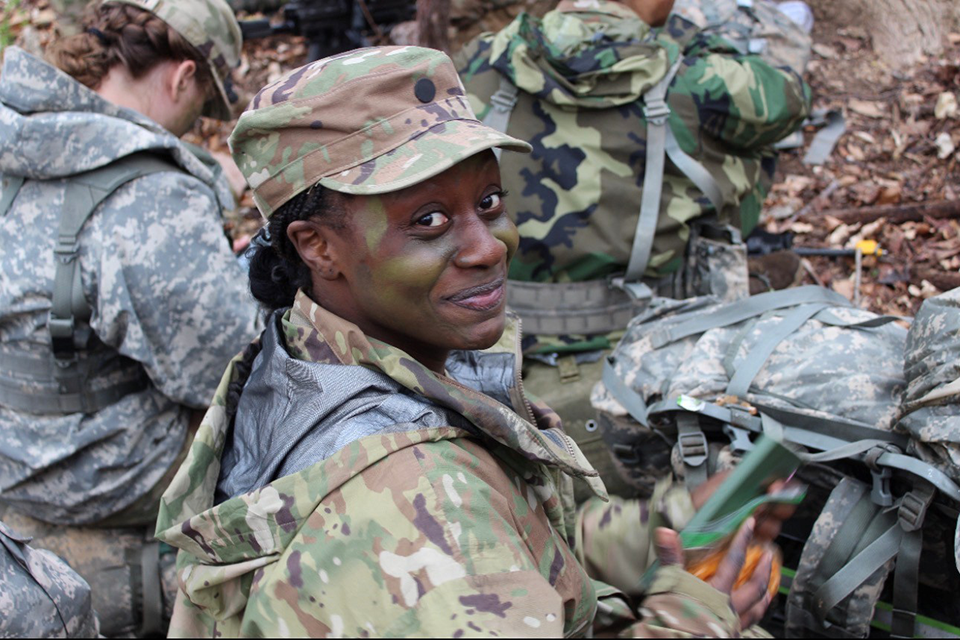
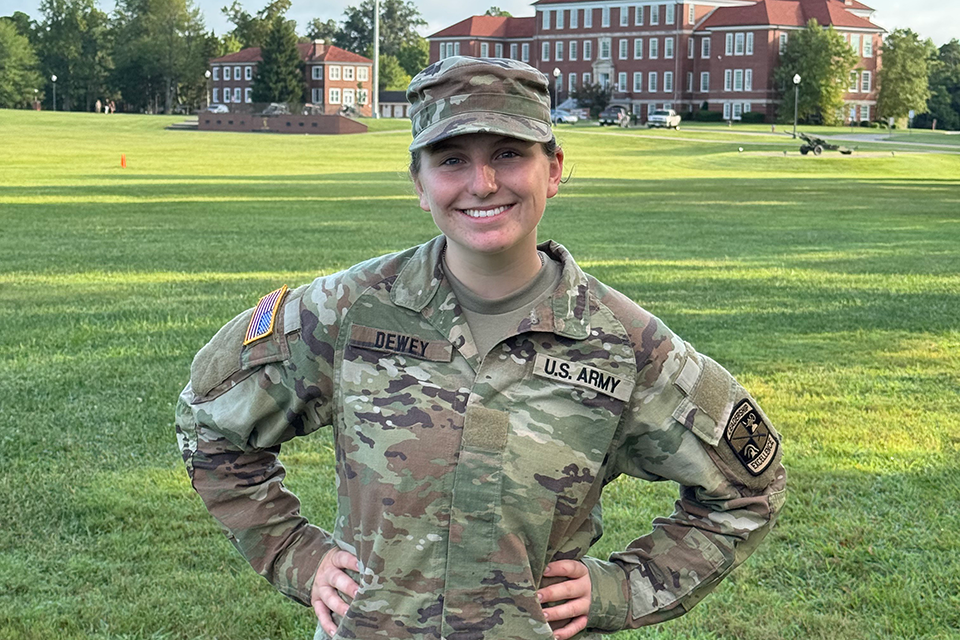
Well before sunrise, UMSON Army Reserve Officers’ Training Corps (ROTC) cadets Rachel Dewey and Jenny Fobang move stealthily across the University of Maryland, College Park (UMCP) campus, shouldering 35-pound backpacks. “Rucking,” or running and walking while carrying weight, is one of the many physical training, also known as “PT,” demands that sets these Bachelor of Science in Nursing (BSN) students at the Universities at Shady Grove in Rockville (USG), Maryland, apart from their nursing classmates.
For some UMSON students, ROTC provides a pathway to earning a BSN, a military commission, and a career in the U.S. Army. Military nursing has been part of UMSON’s story since its inception. First superintendent Louisa Parsons set the precedent; she served as a nurse with the British Army in the early 1880s in Egypt and the Sudan and was awarded the Victoria Royal Red Cross from England and a medal of thanks from the Khedive of Egypt. Following her time at UMSON, she served in the Spanish-American War and in the Second Boer War and at Atlanta's Fort McPherson as part of the U.S. Army Hospital Service.
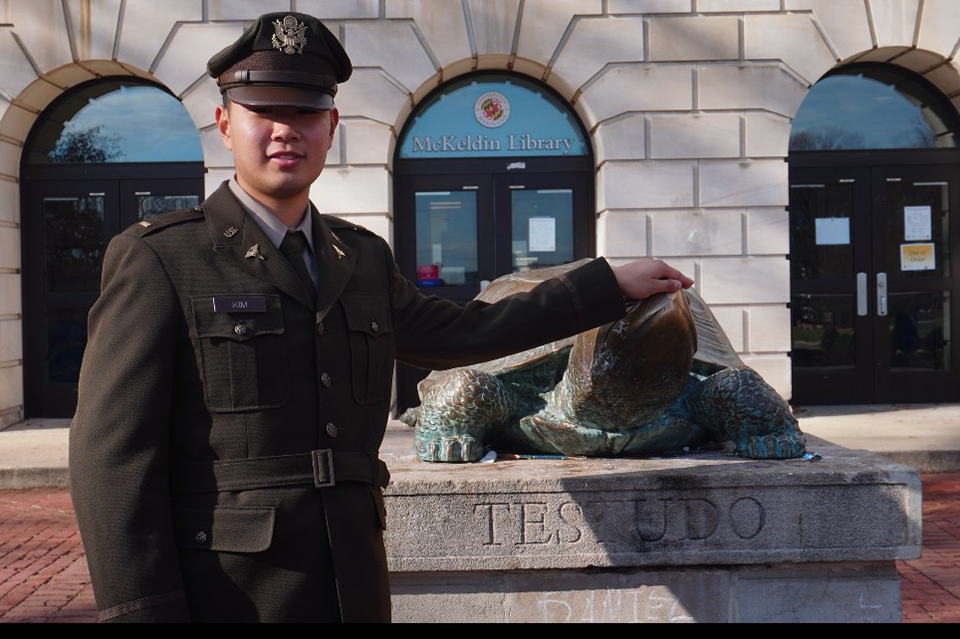
From Navy Corps officers to Army generals, UMSON graduates have served across military branches domestically and internationally. In 2019, UMSON, ROTC, and UMCP entered a formalized nursing pathway agreement. Since then, UMSON has graduated three commissioned Army officers. All three received the ROTC scholarship, a merit-based scholarship provided in return for a period of active military service after graduation.
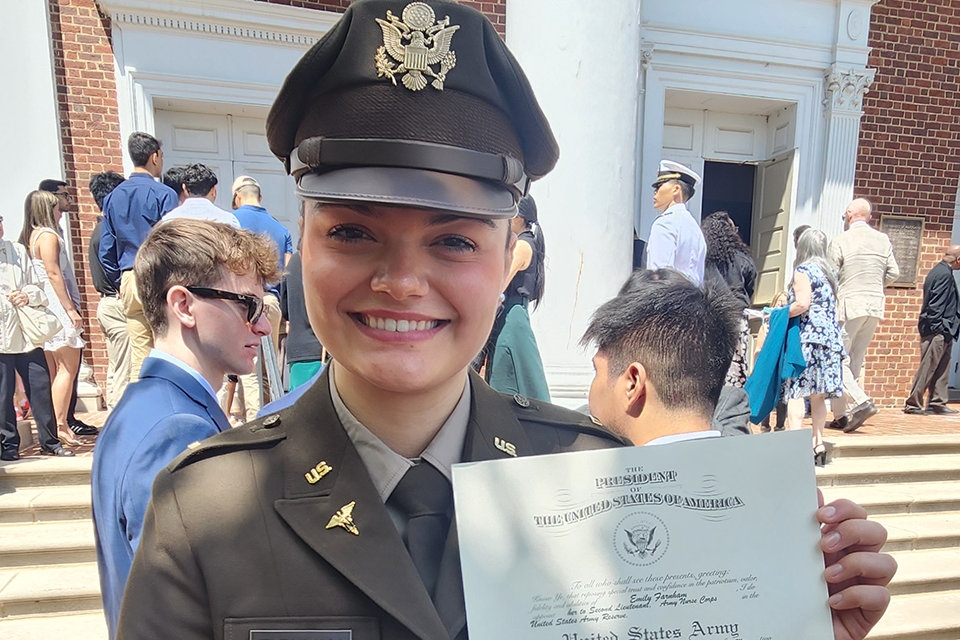
These graduates are 2nd Lts. Rex Kim, BSN ’24; Liah Lawrence, BSN ’25; and Emily Farnham, BSN ’25. Dewey and Fobang, who also received the ROTC scholarship, will graduate in December and are on track to earn their commissions shortly after graduation.
UMSON nursing students in ROTC balance their nursing education with their Army training obligations. Each semester, they take a 3-credit ROTC class and participate in drills at UMCP. This means traveling regularly between College Park, Maryland; USG; clinical sites; and, often, part-time jobs. In addition, some participate in a monthlong, immersive Army Nurse Summer Training Program between their junior and senior years.
“Other students are yawning after waking up at 8 or 9,” Dewey says, while she and Fobang have been up since 5 a.m. “After I’m awake, after I’ve taken part in PT or a ruck, I feel so successful.”
Retired Army Lt. Col. Terry McCall, now the civilian Army ROTC recruiter for UMCP, says ROTC can be a challenge for nursing students. “Their ROTC class is in College Park. The physical fitness training is here. The tactical training that we do every week is here,” he says. So, the ROTC program makes accommodations to “bend and fit around the nursing program,” he explains.
Fobang and Dewey continue to hear that nursing comes first. They’re told, Fobang says, to “put your education first because we need nurses in the military, and we want you to excel.”
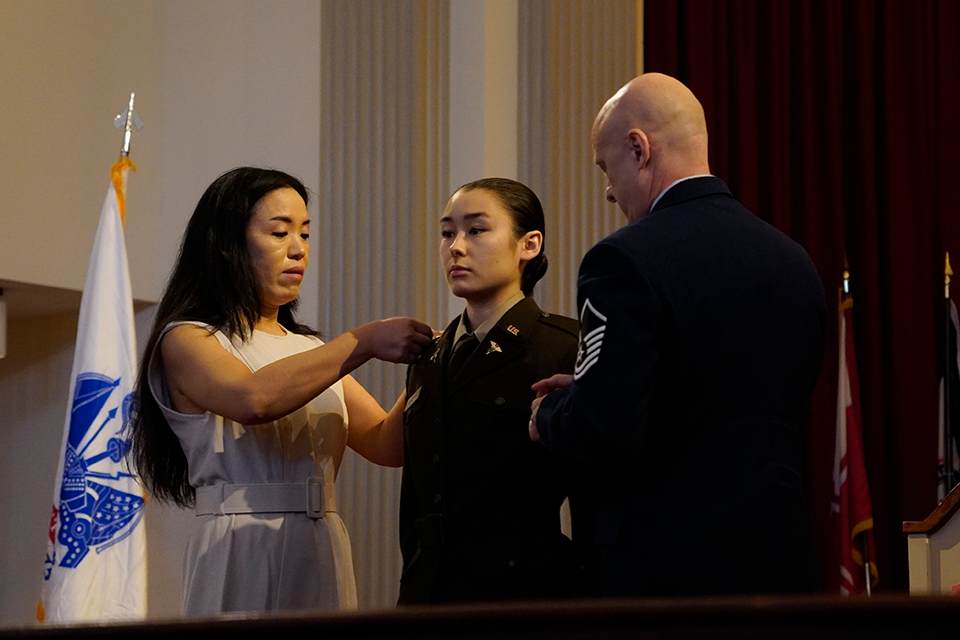
This flexibility, however, doesn’t mean the ROTC nursing students are exempt from passing required testing, tactical training, or physical fitness tests. Completing these requirements and earning their BSN culminates with their commissioning as Army second lieutenants. After graduation, these second lieutenant nurses head to Fort Sam Houston in San Antonio for the Basic Officer Leader Course, where they continue to improve their basic soldier skills, such as fitness, navigation, marksmanship, Army fundamentals, and leadership, and prepare for their first hospital assignments and active duty.
The newly commissioned officers are assigned to one of 14 first duty locations, including Germany, Alaska, and Hawaii. Wherever they go, the assignment starts with a clinical residency as medical-surgical nurses: Kim was assigned to Walter Reed National Military Medical Center in Bethesda, Maryland; Farnham to Martin Army Community Hospital in Georgia; and Lawrence remained in San Antonio, at the Brooke Army Medical Center. The clinical residency lasts six months to a year.
Dewey says she chose the ROTC program to enhance her nursing career with opportunities for travel and training. “I really like the constant ability to advance and learn, take classes through the military, and travel for it,” she says. “I wanted to take part in tactical training. I wanted to learn how to shoot a gun. I wanted to learn how to survive outside and do land navigation.”
All nurses who enter the Army as commissioned second lieutenants do so through ROTC. The U.S. Military Academy, West Point, doesn’t educate nurses, according to McCall, nor do nurses go through Officer Candidate School. As a result, he says, ROTC recruiters are very focused on recruiting enough nursing students, even though the military requires many fewer nurses than the general population, about 200 new nurses per year.
Farnham credits ROTC for the essential time management, leadership, and prioritization skills they developed, all reinforced by UMSON’s rigorous curriculum. Combining nursing knowledge with Army leadership training, she says, continues to shape her into the nurse she is.
“I am proud to be an UMSON alum and feel my education allowed me to excel in the military environment,” she adds. “We are expected to have extensive knowledge of our nursing practice. UMSON prepared me for that. I can relate almost every clinical interaction I've had to something I learned in school.”
Farnham also credits UMSON with developing her strong “research instinct,” explaining, “I’ve taken the idea of research and building a knowledge base into my new role, researching medications, disease processes, and nursing interventions.”
Dewey and Fobang will take the NCLEX exam shortly after graduation and, as with ROTC graduates before them, they’ll head to the Basic Officer Leader Course and continue the UMSON military legacy. From the earliest days of the Spanish-American War to WRAIN (see the content below) to today’s ROTC program, UMSON’s nurses have demonstrated clinical excellence and leadership across the eras of modern military service.
Though Congress established the Army Nurse Corps in 1901, nurses didn’t become commissioned officers for nearly 50 years. As demand grew for baccalaureate-educated nurses, programs such as the Walter Reed Army Institute of Nursing (WRAIN) emerged.
In 1964, about halfway through the Vietnam War, the Army approached UMSON for help filling a shortage of approximately 2,000 BSN nurses. UMSON created a program at Walter Reed Army Medical Center staffed with faculty from the Army Nurse Corps and with a curriculum identical to that of UMSON’s program in Baltimore.
The first WRAIN students graduated in 1968. Over the next 10 years, WRAIN graduated approximately 1,200 students, all of whom were commissioned into the Army Nurse Corps.
By the late 1970s, shifting military priorities closed the program. A 1978 handwritten memo found in UMSON’s archives states:
“Although both [the Army Nurse Corps and the School of Nursing] regret that cutbacks in armed services programs and personnel have necessitated its termination, there is concurrence that the high quality of nursing care demonstrated by WRAIN graduates will remain a lasting testimonial to its success!”