Public Policy and Advocacy
Raise Your Voice
Nurses need to be active in influencing health policy, but sometimes don’t know how to get involved.
Becoming informed and developing advocacy skills are first steps. As students you can do both by participating in opportunities on campus and off.
Get Involved:
Local Opportunities
Maryland Action Coalition Summit
The Maryland Action Coalition (MDAC) serves as one of the driving forces for transforming state health care. Recognizing the important work already underway in Maryland and with a goal of improved health outcomes for its residents, the Maryland Action Coalition leads innovation in the health of the population through efforts that build and sustain a culture of health.
President's Panel on Politics and Policy Speaker Series
This speaker series examining issues important to the UMB community that are likely to be affected by the new presidential administration and the new Congress.
American Association of Colleges of Nursing Student Policy Summit
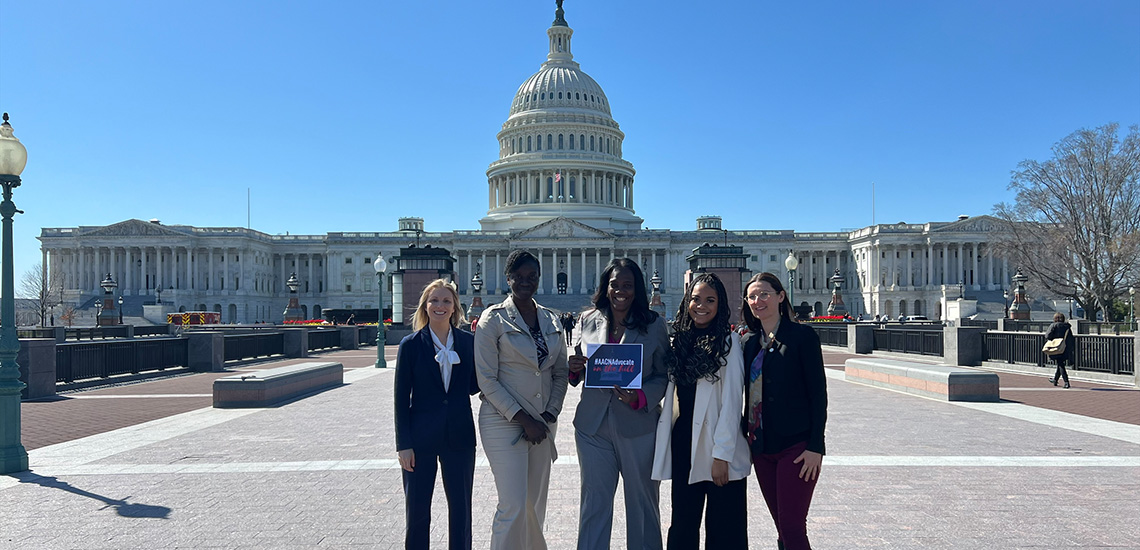
The American Association of Colleges of Nursing (AACN) hosts its annual Student Policy Summit in Washington, D.C., typically in March. The two-day conference is open to baccalaureate and graduate nursing students enrolled at an AACN member institution, and UMSON typically selects and sponsors several students from both the Baltimore and Universities at Shady Grove locations to attend. The application process is competitive and requires submission of an essay. The call for applications is promoted annually, usually in the fall, through The Elm.
Students who attend the summit are immersed in didactic program sessions focused on the federal policy process and nursing’s role in professional advocacy. They have the opportunity to engage directly with speakers, who are leaders in the policy arena; AACN staff; and U.S. representatives and senators. Participation in the summit offers students the tools to advocate for issues that truly matter to them, their patients, and their communities. Students can also meet, connect, and network with a diverse group of fellow nursing students from across the country.
Policy News
Utilize these resources to stay abreast of policy issues.
American Association of Colleges of Nursing
- browse the government affairs section of their website
- sign up for the Washington Weekly Newsletter and other updates
American Nurses Association
- browse their health policy website
- browse their advocacy website
- sign up for Capitol Beat updates
- sign up for RNAction updates
Commonwealth Foundation
Kaiser Health News
- browse their website on health policy issues
- sign up for daily First Edition and Morning Briefing emails
Kaiser Family Foundation
- browse their website, including the section on Affordable Care Act news
- sign up for their newsletters
Health Affairs
Additional Resources
- American Academy of Nursing
Policy webpage - American Association of Nurse Practitioners:
Legislation/Regulation website - American Association of Nurse Anesthetists:
Advocacy webpage - American Public Health Association:
Advocacy for Public Health website - Center to Champion Nursing:
Campaign for Action website - Healing Politics
Healing Politics website - Maryland Academy of Advanced Practice Clinicians (MAAPC)
Policy website - Maryland Nurses Association
Association website - National Association of Pediatric Nurse Practitioners (NAPNAP) Chesapeake Chapter
Chapter website - National Organization of Nurse Practitioner Faculties:
Health Policy website - Nurse Practitioner Association of Maryland (NPAM)
Legislative webpage
Maryland Healthcare Workforce Advocacy Legislative Toolkit
Created by an UMSON DNP student for students, this nonpartisan resource equips Maryland health care professionals and stakeholders to participate effectively in the Maryland General Assembly. The toolkit explains committees, hearings, and timelines in plain language and provides basic layouts for testimony, email, and call templates, plus a two-minute story framework, to help you translate experience into policy impact.
Access the home page and navigate among the toolkit’s pages to learn more about the Maryland legislative process and where you can make your impact. Identify your senator and three delegates, personalize a template with your experience, and follow the session calendar prompts to act at the right moment.
This is an UMSON student’s DNP Quality Improvement project, meant to fill the structural gap of an evidence-based, easily accessible, Maryland-specific, online health care workforce advocacy toolkit.