UMSON Celebrates a Year of Belonging, Innovation, and Impact
 The University of Maryland School of Nursing (UMSON) celebrated a year of accomplishments in education, research, and partnership with the community at its 2026 State of the School event, highlighting how it is preparing the next generation of nurse leaders and improving health across Maryland and beyond.
Centered on the themes of belonging and innovation, the Oct. 1 event featured TED Talk-style stories from faculty and staff about expanding educational opportunities, strengthening Maryland’s nursing workforce, bringing health services into communities, and advancing research to improve patient care.
 “Belonging is more than a feeling,” said Yolanda Ogbolu, PhD ’11, MS ’05, BSN ’04, NNP, FNAP, FAAN, the Bill and Joanne Conway Dean of the University of Maryland School of Nursing, in her opening remarks. “It’s an intentional strategy for shared excellence.”
Ogbolu emphasized the School’s role in preparing nurses across the educational continuum, from bachelor’s degrees through doctoral programs, and in supporting the state’s nursing workforce. During the past year, 753 students graduated from UMSON, including more than 500 new nurses. Those new graduates accounted for 40% of newly licensed nurses in Maryland, she said.
Expanding pathways into nursing
Access to education was a central theme in presentations by faculty and staff working to address barriers to entering and advancing in the nursing profession.
 Samantha Hoffman, DNP ’23, Cert ’21, MS ’16, CPNP-PC, assistant professor and vice chair of the Department of Family and Community Health, discussed the development of a hybrid RN-to-BSN program on Maryland’s Eastern Shore. Drawing on her experience caring for children and families in the region, Hoffman described the financial, transportation, childcare and technology challenges that can prevent aspiring nurses from pursuing their goals.
Rather than expecting students and working nurses to travel to Baltimore, UMSON partnered with students, nurses, health care leaders and community partners to understand local needs and develop an educational option designed for the region.
The effort reflects a broader commitment to building opportunities with communities, Hoffman said, listening to their concerns and drawing on their strengths.
“It is not a lack of talent, a lack of passion, or a lack of desire to serve. We have that in spades on the Shore,” she said. “So, what is the problem? Access.”
 Another presentation focused on strengthening the clinical education infrastructure that supports nursing students. Danielle McCamey, DNP, CRNP, ACNP-BC, FAAN, FAANP, FCCP, FADLN, assistant professor and associate dean for clinical partnerships and innovation, and Lori Harris, BA, director of the Office of the Registrar and Student Placements, described the challenges nursing schools face in securing clinical placements for students.
“When most people think about nursing education, they see students, faculty, the simulation labs, the hospitals, but behind every nursing student is something few people think about: a clinical placement,” McCamey said.
During the 2025 - 26 academic year, UMSON filled more than 5,600 clinical placement slots across more than 130 sites. With a $661,479 Nurse Support Program II grant from the Maryland Higher Education Collaborative, UMSON is developing the Maryland Clinical Placements Collaborative to strengthen this work through streamlined processes, shared data, and a sustainable statewide system.
The goal is to expand clinical education capacity and help ensure that qualified nursing students can access the experiences they need to enter practice.
Preparing nurses to shape policy
 Each speaker approached the front of the auditorium accompanied by a song of their choice. For Yvette Conyers, DNP, RN, FNP-C, CTN-B, CFCN, CFCS, CNE, FADLN, CWCN-AP, FNAP, FAAN, associate dean for strategic engagement and impact, it was McFadden & Whitehead’s 1979 hit “Ain’t No Stoppin’ Us Now,” which she described as “one song that captures the spirit of today’s conversation.”
“This song celebrates progress, possibility, and the courage to move beyond boundaries that others place before us. In many ways, that’s the story of nursing leadership,” she said.
UMSON’s impact also extends beyond clinical care. The inaugural Nursing Policy Academy, a 10-month program spearheaded by Conyers, introduced pre-licensure nursing students to policymaking, advocacy, and leadership.
Inspired in part by the example of alumna and former Maryland state Sen. Shirley Nathan-Pulliam, DHL (Hon.), MAS, BSN ’80, RN, FAAN, Conyers said, the academy encourages students to recognize that nurses can influence the systems and policies that shape health care.
Bringing care into communities
Presentations also underscored the importance of partnerships that bring nursing expertise directly to people where they live, learn, and gather.
 Michelle R. Spencer, DNP ’19, MS ’06, BSN ’84, RN, assistant professor and director of the Master of Science in Nursing Community/Public Health Nursing specialty, which celebrates its 60th anniversary this year, reflected on lessons she learned growing up in West Baltimore, where she saw how neighborhood resources and access to services can influence health.
“The most important lessons I’ve learned about health didn’t come from nursing school, the textbook, or the hospital,” she said. “It came from the community where I grew up.”
That understanding continues to inform UMSON’s community-based work. Since 2023, more than 400 students have participated in the Healthcare in the Library initiative, connecting with more than 2,500 Baltimore residents through blood pressure screenings, health education, resource navigation, and other services.
Spencer emphasized that effective community health work begins with trust, listening, and relationships. Communities, she said, are not problems to solve but partners from whom health professionals can learn.
 Bridget Gourley, DNP ’08, FNP-BC, FACU, FNAP, associate professor director of the Doctor of Nursing Practice (DNP) Family Nurse Practitioner specialty, and Shannon K. Idzik, DNP ’10, MS ’03, CRNP, ANP-BC, FAANP, FAAN, professor and associate dean for the DNP program, described the development of a new nursing faculty practice for the School. With approval from the University System of Maryland Board of Regents, the initiative has moved from a long-standing vision to reality, creating a structure to sustain and grow faculty clinical practice.
“The idea of a nurse-managed health center or faculty practice has been tossed around the halls of this building for decades,” Idzik said.
Rather than being limited to a single building, the model will bring care to community settings, including Head Start programs, the Governor’s Wellmobile sites, and senior housing centers. The school is also developing plans for an interprofessional clinic at the Universities at Shady Grove with colleagues from dentistry, pharmacy, and social work.
The model is intended to connect clinical practice, student learning, research, and community needs while supporting longer-term partnerships and expanded care.
Research that improves everyday life
Research remains another cornerstone of UMSON’s work. Despite diminished or delayed federal funding opportunities in recent years, faculty submitted 102 proposals during the past year, a 10% increase over the prior year. They secured 28 research grants and 107 non-research awards, totaling $10.7 million in funding, Ogbolu said.
The School’s research portfolio includes support from the National Institutes of Health, including the National Institute of Nursing Research, National Institute on Aging and National Cancer Institute, as well as foundations and other partners.
 Sarah Holmes, PhD, MSW, associate professor, highlighted UMSON’s research on aging and dementia, focusing on how meaningful activities can improve quality of life for people living in long-term care.
Holmes shared an experience from her student years, when she partnered with a woman with dementia through an art program. By taking time to build a connection before beginning the activity, Holmes saw the woman move from anxiety and restlessness to smiling, laughing, and participating.
That experience helped shape Holmes’ research into meaningful activities for people with dementia. In randomized controlled trials, the approach was associated with fewer behavioral symptoms and better overall quality of life among participants.
The work reflects a larger principle, Holmes said: How care is delivered matters just as much as what is done. Understanding what gives people meaning, connection, and purpose can help improve their everyday experiences.
“When there's little to do that feels meaningful, people can become bored, disengaged, or distressed,” she said. “And rather than ask, how can we manage this distressing behavior, we can ask, what is this person trying to tell us?”
 Building on a shared commitment
Throughout the event, speakers returned to the role of collaboration in advancing the School’s mission; their presentations illustrated how UMSON works with students, faculty, staff, alumni, donors, and partners to address complex health challenges.
In closing, Ogbolu thanked the School community for its contributions and reiterated UMSON’s commitment to lead, partner, innovate, and prepare the next generation of nurse leaders.
 “As we look ahead, the path is clear for the University of Maryland School of Nursing,” she said. “We will continue to lead, to share, to partner, to innovate and discover, and prepare the next generation of nurse leaders.”
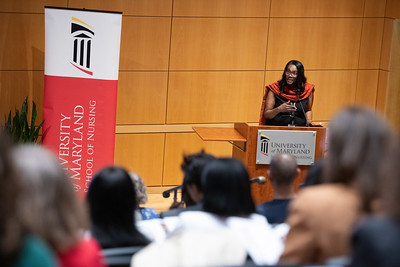 “I vividly remember one unforgettable conversation. It was a student who came to my candidate interview,” Ogbolu said in her first State of the School address, which was held April 23, 2024. “He gave me a glimpse of what it means to be a student here in the School of Nursing. He and his peers arrived very early in the morning. They had to get here about eight o’clock in the morning to have an opportunity to be here for the interview. And he was well prepared,” she said, adding that the student came in with a long list of questions, as well as potential solutions he had for how the School can better support students.
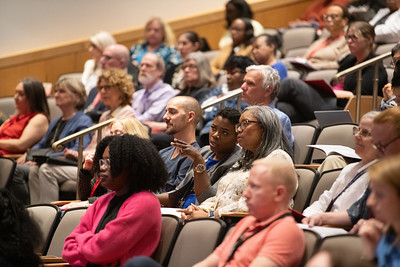 Ogbolu’s role as dean comes as a major redesign in nursing curriculum, to align with the American Association of Colleges of Nursing’s new Essentials, is underway, one that impacts all nursing schools across the country. The new curriculum, Ogbolu said, is focused on preparing practice-ready nurses.
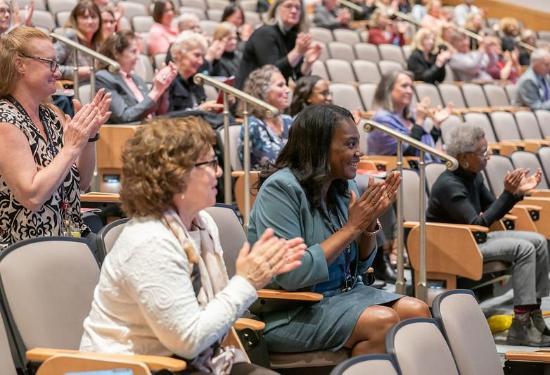 More than a decade later, Kirschling, who will retire this year, said the work the institution has accomplished since 2013 “goes beyond what I could have imagined.”
 Community and public health has also remained a primary focus for the School, through multiple partnerships throughout Baltimore City.
 “Many times during COVID, I believe she gave us a an ounce of common sense when we needed it badly,” he said, referencing Kirschling’s leadership in standing up and running the UMB COVID-19 vaccine clinic and the School’s “early-exit” initiative, which, in response to then-Gov. Larry Hogan’s request, allowed nursing students who had met the requirements for graduation to work as nursing graduates prior to their formal graduation. Over the course of four semesters, 614 nursing students began service under this initiative.
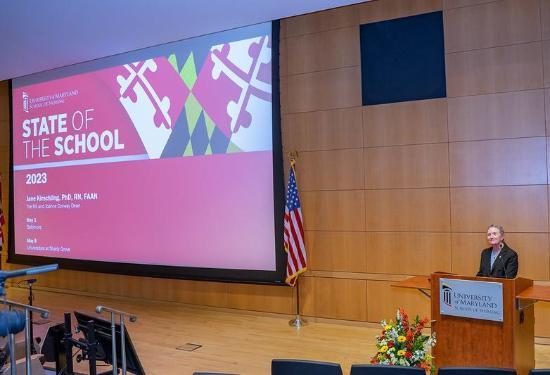
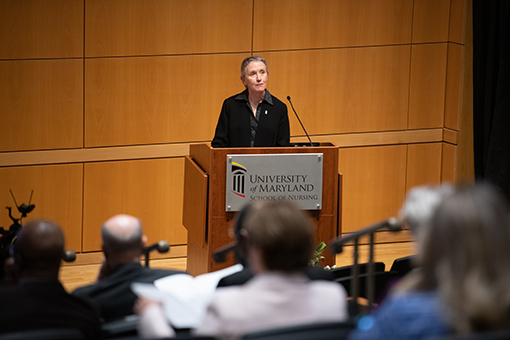
 Speaking to an audience of UMB leadership; UMSON faculty, staff, and students; and invited guests, Kirschling outlined highlights in the areas of education, faculty research and scholarship, collaboration, and community engagement.
 “It is in teaching and learning,” Kirschling said. “We have emerged from a pandemic that demanded regular and rapid changes in order to keep teaching and learning on track as we vacated our classrooms. We were fortunate to have faculty who were well versed in teaching online or in virtual environments and to have a strong infrastructure in learning technologies.”
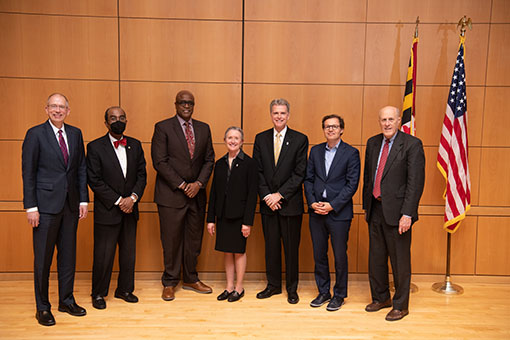 “As we look ahead to continued statewide competition for clinical sites, the innovative approaches tested during the pandemic coupled with our outstanding Standardized Patient Program will help us continue to develop high-quality clinical experiences,” Kirschling said.
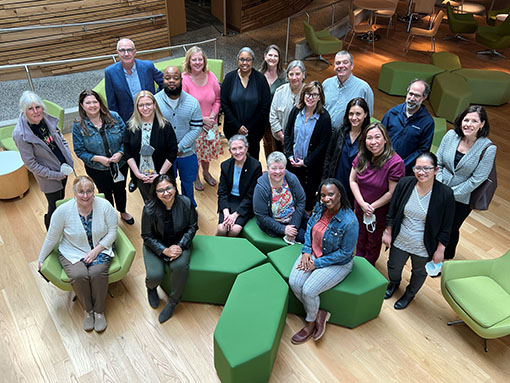 “As we look ahead to another year and the early stages of our 2022 - 2026 strategic plan, we are indeed developing new initiatives that will ‘shape the profession of nursing and the health care environment by developing leaders in education, research, and practice,’” said Kirschling, citing UMSON’s mission. “As always, we are doing this in the context of our commitment to ‘improve the human condition and serve the public good.’ And you can be quite certain that our work will engage us all in ongoing innovation and discovery.”
 Speaking to an audience that included University of Maryland, Baltimore (UMB) leadership; UMSON faculty, staff, students, and alumni; and invited guests, Kirschling focused on education, faculty research and scholarship, diversity and inclusion, collaboration, and community engagement.
 “We take seriously our responsibility as an institution within the University of Maryland, Baltimore, and the University System of Maryland to serve as a leader for excellence in nursing throughout the state,” she said. “As we respond to these forces, our actions are informed by the 2017-2021 Strategic Plan for the School of Nursing and the foundation provided by the University plan. We are now about one year into implementation of the plan, and it has guided our priorities.”
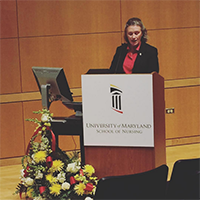
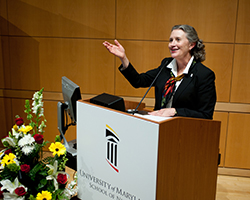 Dean Jane M. Kirschling, PhD, RN, FAAN, recently delivered her 2016 State of the School address to University of Maryland, Baltimore (UMB) leadership, School of Nursing faculty and staff, and other special guests. During her address, Transforming Nursing: Living Our Core Values, Dean Kirschling informed attendees about how the School is responding to some of the significant challenges facing nursing, while maintaining the core values of UMB and the School of Nursing.
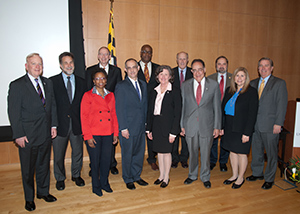 (right) Dean Jane Kirschling with colleagues at her first annual State of the School address.