Traditions
The Nursing Pin
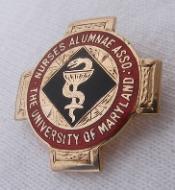
When Bellevue Hospital in New York started a nurses’ training school in 1873, a board member suggested “a badge for the probationers and the same with a medal attached for the head nurses.” Out of this idea came the concept of a nursing school pin. Bellevue presented its first pins — the first nursing school pins — in 1880.
The University of Maryland School of Nursing opened in 1889, and the tradition of a class pin began in 1894, when students selected a design by Tiffany’s of New York. None of these original pins survive, but the official School of Nursing pin is a modified version of the original design.
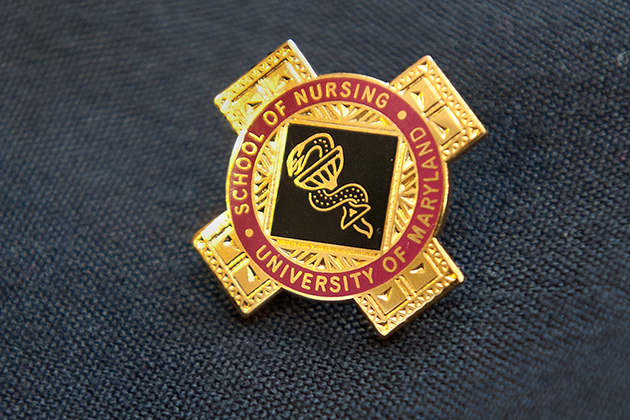
The design features the St. George’s cross in gold. In the center of the cross is a variant of the bowl of Hygeia, the serpent representing wisdom, entwined around a glass that is symbolic of the “wise presiding over decoctions of medicine.” Though commonly a symbol used by pharmacists, the variant on the pin is the snake design found on the wand of Asclepius, a symbol used by the nursing profession. The bowl of Hygeia is set on a field of black surrounded by gold with a maroon circle around it containing the words, “University of Maryland School of Nursing.”
While subsequent classes had different class pins designed, when the School of Nursing Alumni Association (founded in 1897) decided on a pin to represent the Alumni Association, they chose that original 1894 design as the model. Until 1970, the pin was only allowed to be worn by paid members of the Alumni Association. Graduates paid dues to be included in the organization, and only then were they permitted to wear the pin. Only one jeweler in Baltimore was allowed to make the pins, and purchasers had to show proof of Alumni Association membership to purchase one. This pin looked the same as today’s UMSON pin, but with the words “University of Maryland Alumnae Association” inscribed on it. Many members of the Alumni Association had their initials or name, as well as class year, engraved on the back of their pin, and it was a cherished part of every alumna's uniform.
In 1970, the Alumni Association offered the design of the alumni pin to the dean of the School of Nursing to become the official nursing pin. It is now awarded to all graduates of the University of Maryland School of Nursing.
The Nursing Cap
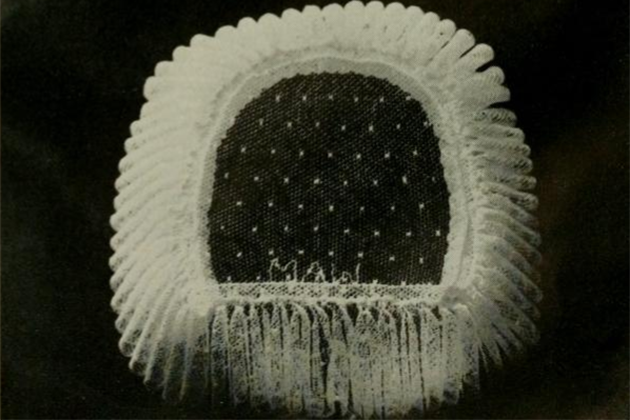
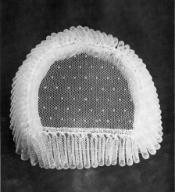 The University of Maryland School of Nursing cap, known as the “Flossie,” was designed in 1892 by the School’s first superintendent, Louisa Parsons, who modeled it after one of Florence Nightingale’s own caps. The elaborate point d’esprit lace was made in England and required special care to maintain. Convinced that too much time and effort went into making and laundering the lace Flossie, in 1900 then-Superintendent Katherine A. Taylor simplified the design and designated it as the graduate cap.
The Flossie was UMSON’s official graduate cap and served for decades as a symbol of the wearer’s professionalism and the School’s connection to the founder of modern nursing. Several traditions surround the Flossie at UMSON: In the early years, a ceremony known as “capping” took place as a rite of passage. From the late 1950s onward, an event was held for the seniors, who were taught how to string their Flossie caps in the final weeks before graduation. In later years, a fluting ceremony was held after the six-week probationary period for each student nurse. If she was progressing satisfactorily, she was allowed to flute her cap and continue her studies. By the 1970s, the fluting tradition continued, though it no longer marked the end of the probationary period. The fluting banquet grew into an involved night that included skits, songs, laughter, and food, in addition to seniors helping the juniors learn how to flute their caps.
Welcome Ceremony

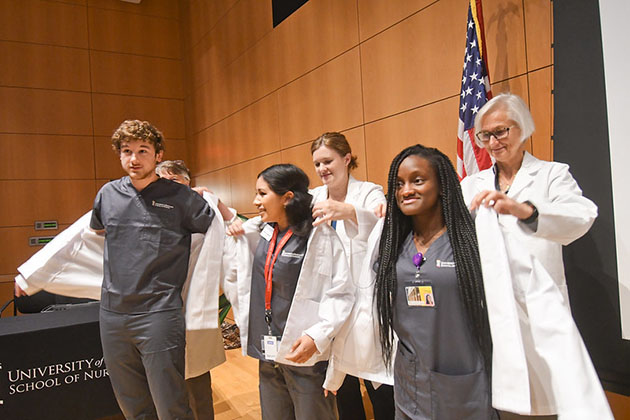
Since 2014, incoming Bachelor of Science in Nursing (BSN) and Master’s-Level Entry-Into-Nursing students at both our Baltimore and Universities at Shady Grove locations are cloaked in scrub jackets at a Welcome Ceremony that is the culminating event of new student orientation.
This ceremony marks the first time students don the professional uniform of a nurse, and they receive a scrub jacket from an UMSON alumnus, welcoming them to the profession. Students are invited to reflect on their commitment to improving lives and health outcomes.
Each ceremony includes:
- cloaking of students in scrub jackets
- an address by an exemplary alumnus
- the recitation of the nursing pledge
- receiving of the Arnold P. Gold Foundation (APGF) Keeping Healthcare Human lapel pin
- a reception for students.
The School was one of 100 nursing schools to receive funding support through a collaborative effort between the APGF and the American Association of Colleges of Nursing to pilot such ceremonies. The purpose of the program is to instill a commitment to providing compassionate care among future health professionals entering nursing schools. Keeping Healthcare Human pins are a gift from APGF, initiators of the first White Coat Ceremony in 1993.
View galleries and materials from past ceremonies:
| Year | Materials |
|---|---|
| 2026 | |
| 2025 | |
| 2024 | |
| 2023 |
If you would like access to older photo galleries, please email us at nrscommunications@umaryland.edu.
Uniforms
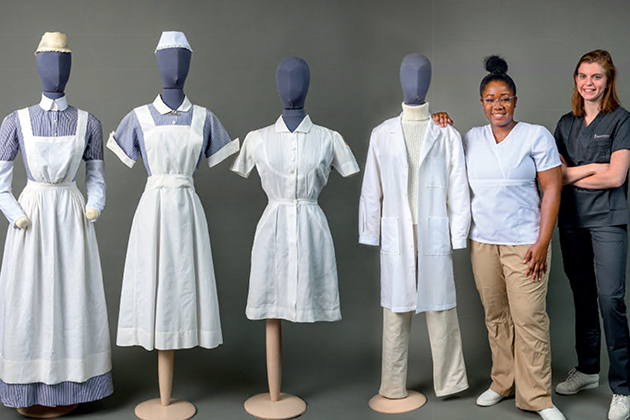
With a history as old as the School itself, UMSON’s student uniforms through the ages reflect nurses’ professional and societal roles.
Tailored uniforms that covered neck to toe and conveyed authority were the standard for nursing schools nationwide in the 1890s, when UMSON first opened its doors.
As decades passed, skirts and sleeves grew shorter, but aprons and caps remained until the second half of the 20th century.
As the women’s movement took hold, and nurses occupied new roles, uniforms became more practical. Scrubs and lab coats eventually became the norm as nurses claimed their space as scientists and practitioners who are critical members of the professional health care team.
In fall 2020, entering Bachelor of Science in Nursing and Clinical Nurse Leader master’s students donned new scrub uniforms – graphite gray with an embroidered UMSON logo – that replaced the previous white scrub tops and khaki pants, introduced in the mid-2000s.
The historical uniforms pictured here are all housed in UMSON’s Living History Museum.