
AI in Maryland Higher Education Program

AIM-High is a statewide professional development program that helps academic and clinical nurse educators integrate generative artificial intelligence (GenAI) with confidence, creativity, and purpose. Through Foundation and Master Class webinars, participants will learn practical strategies to save time, strengthen teaching, support learners, and promote responsible GenAI use.

The learning does not stop with the webinars. Participants may advance into the AIM-High Innovation Lab, where selected nurse educators work with mentors to develop real-world AI integration projects. These projects will be showcased at the AIM-High Symposium, a culminating event focused on sharing ideas, outcomes, and innovations across Maryland nursing education.

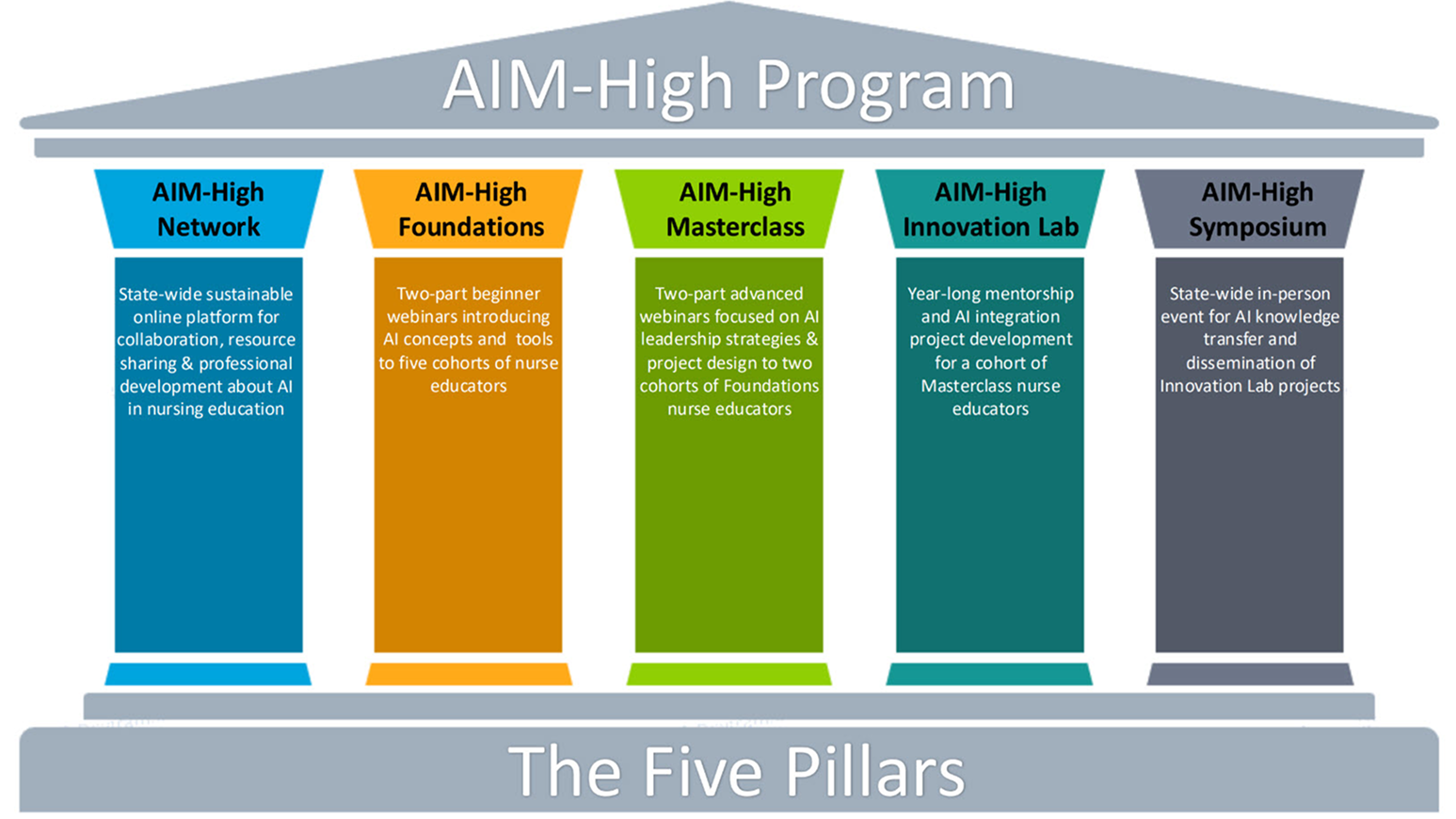
AIM-High Program – The Five Pillars

Five Pillars: Network, Foundations, Masterclass, Innovation Lab, and Symposium

AIM-High Network
State-wide sustainable online platform for collaboration, resource sharing & professional development about AI in nursing education

AIM-High Foundations
Two-part beginner webinars introducing AI concepts and tools to five cohorts of nurse educators

AIM-High Masterclass
Two-part advanced webinars focused on AI leadership strategies & project design to two cohorts of Foundations nurse educators

AIM-High Innovation Lab
Year-long mentorship and AI integration project development for a cohort of Masterclass nurse educators

AIM-High Symposium
State-wide in-person event for AI knowledge transfer and dissemination of Innovation Lab projects


Who It’s For:

Maryland nurse educators across academic and clinical settings who want to build AI knowledge, expand their teaching capacity, and prepare learners for practice in a technology-enhanced healthcare environment.

Why Participate?

Nurse educators are already exploring GenAI, but many need structured support to use these tools effectively, confidently, and responsibly across academic and practice settings. AIM-High meets that need through practical, relevant learning experiences that can be applied immediately. Participants will gain foundational knowledge and develop the skills to thoughtfully integrate GenAI into teaching, assessment, and program design.
AIM-High helps participants:

Strengthen teaching strategies
Design more engaging, interactive, and learner-centered learning experiences grounded in current pedagogical best practices.

Increase efficiency and productivity
Use GenAI to streamline course planning, content development, feedback generation, and routine educator workflows, freeing time for higher-value teaching and mentorship.

Enhance learner assessment and feedback
Refine learning objectives, design meaningful assessments, and provide timely, personalized feedback that supports student success.

Use AI responsibly
Apply GenAI in ways that uphold academic integrity, protect privacy, and promote ethical, safe, and transparent educational use.

Build confidence and leadership in AI integration
Move beyond basic awareness toward confident, practical leadership in integrating AI across courses, programs, and institutions.

Receive access to a premium ChatGPT subscription for a limited time
Access premium ChatGPT at no cost for a limited period to support hands-on learning and experimentation throughout the program.

Webinar Series

AIM-High Foundations is a beginner-friendly, two-part webinar series that introduces nurse educators to essential GenAI tools, teaching strategies, and responsible use in education.

AIM-High Master Class is an advanced, two-part webinar series that builds on the Foundations experience through a focus on leadership, implementation, and AI-driven innovation in teaching.

Cohort Structure The program is organized into cohorts to support shared learning, peer connection, and structured progression. Across the initiative, AIM-High will offer five Foundations cohorts and two Master Class cohorts.

Save the Date for Upcoming Webinars
Please review the cohort dates and mark your calendar for the option that best fits your schedule. A formal recruitment process will begin soon. In the meantime, you may complete this form to indicate your interest.

Interest Form

AIM-High Foundations Sessions


Dates

Times (EST)

Cohort 1

September 16, 2026

9am-12pm

September 23, 2026

9am-12pm

Cohort 2

October 6, 2026

12pm-3pm

October 13, 2026

12pm-3pm

Cohort 3

November 6, 2026

8am-11am

November 13, 2026

8am-11am

Cohort 4

February 2027 TBD

TBD

February 2027 TBD

TBD

Cohort 5

March 2027 TBD

TBD

March 2027 TBD

TBD

AIM-High Master Class Sessions


Dates

Times

Cohort 1

April 2027 TBD

TBD

April 2027 TBD

TBD

Cohort 2

May 2027 TBD

TBD

May 2027 TBD

TBD


 Aim-High Foundations Session Objectives:

  1. Discuss core GenAI concepts, capabilities, and limitations in nursing education contexts.
  2. Explore ethical, privacy, security, and academic integrity principles related to GenAI use in nursing education.
  3. Apply GenAI tools to improve educator efficiency and productivity in common academic tasks.
  4. Evaluate GenAI-generated evidence-based resources for accuracy and relevance to teaching.
  5. Develop learner-centered teaching activities using GenAI to support student engagement.

AIM-High Master Class Session Objectives:

  1. Design GenAI-supported courses aligned with learning objectives, competencies, and standards.
  2. Develop competency-based assessments and evaluation strategies integrating GenAI.
  3. Analyze learner assessment data using GenAI to inform instructional decisions.
  4. Plan learner-centered educational experiences using GenAI for diverse learner needs.
  5. Implement responsible leadership strategies for GenAI at the course or program level.

Team Member Bios

Cheryl A. Fisher, EdD, MSN, RN

Associate Professor and Co-Director, University of Maryland School of Nursing
Project Director for the AIM-High Program

Cheryl Fisher, EdD, MSN, RN is an Associate Professor and Specialty Co-Director at the University of Maryland, Baltimore, School of Nursing. She oversees the Masters of Science in  Informatics (MSN) program and the Nursing Informatics Certificate Program. She teaches the capstone courses for the students in the MSN program. She has a research background focused on teaching with technology, translating evidence into health care practices, and evaluating the integration of technology into practice. She recently directed the revision of the Nursing Informatics Master’s program focusing on AACN competency-based education along with the NI Faculty, to include basic and responsible use of AI into the curriculum. Fisher was recently awarded a large grant from the state of Maryland to lead nurse educators in the use of  AI tools to facilitate their teaching practice. Fisher is also a sought after speaker for her expertise in AI and is leading faculty in the development of a textbook on AI in Nursing Education for nurse educators. Fisher is formally from the National Institutes of Health, Clinical Center,  where she worked as a Clinical Research Nurse, Director of Nursing Education, Liaison to the Department of Clinical Research Informatics and then as a member of the Nursing Executive Team developing programs and an Evidence Based Practice Fellowship for the research nurses. Fisher currently serves on the UMB AI Teaching and Learning Task Force.


Charlotte Seckman, PhD, RN, NI-BC, CNE, FAAN

Associate Professor and Co-Director, University of Maryland School of Nursing
Co-Project Director for the AIM-High Program

Charlotte Seckman, PhD, RN, NI-BC, CNE, FAAN is an Associate Professor, Specialty Co-Director Nursing Informatics, and Program Co-Director of the Nursing Informatics Certificate programs at the University of Maryland School of Nursing, Baltimore. Board certified in nursing informatics and nursing education, Seckman has more than 25 years of experience integrating technology across government, private, and academic healthcare settings, with a career focused on strengthening practice and education through innovation.

Seckman’s research portfolio spans the development and evaluation of artificial intelligence (AI) platforms and virtual teaching assistants; the design, implementation, and optimization of electronic health record systems; and the creation of personalized decision support tools to improve clinical outcomes. Additional areas of scholarship include protocol mapping, educational technologies, building community in online learning environments, and expanding the development and evaluation of nursing informatics competencies. Seckman also holds advanced graduate certificates and experience in artificial intelligence and aging and applied thanatology, informing interdisciplinary work at the intersection of technology, education, and human experience. A prolific scholar and sought-after speaker, Seckman has authored more than 30 peer-reviewed articles and book chapters and has delivered over 200 lectures, speeches, and workshops on various nursing informatics topics to include generative AI in education and clinical research practice. Widely recognized as an expert in nursing informatics, Seckman is committed to preparing the next generation of clinicians and leaders to use data, technology, and AI to strengthen care delivery, education, and health outcomes.


Cory Stephens, DNP, MSN, RN, CNE, NI-BC, CPHIMS, FHIMSS

Assistant Professor, University of Maryland School of Nursing
Co-Project Director for the AIM-High Program

Cory Stephens, DNP, MSN, RN, CNE, NI-BC, CPHIMS, FHIMSS is an Assistant Professor in Informatics Nursing at the University of Maryland School of Nursing and a systems thinker dedicated to raising the bar in education through technology. An ANCC board-certified Informatics Nurse Specialist and NLN Certified Nurse Educator, he also holds the CPHIMS credential and a post-graduate certificate in Teaching in Nursing and Health Professions. Stephens serves as Co-Project Director for the AIM-High Program, a statewide initiative that strengthens AI literacy and responsible adoption for nurse educators. He co-leads the UMB AI Teaching and Learning Task Force, driving institutional strategy for AI integration in the classroom. His widely published and presented work focuses on translating generative AI into practice-ready strategies for competency-based education, scalable faculty support, and high-quality feedback workflows.

A recognized leader in AI pedagogy, he is currently an AI Studio at UMB Fellow and a USM Generative AI Pedagogy Fellow. As a co-founder of the Faculty AI Champion Program, he has developed a suite of AI-enabled teaching tools and custom GPTs, including JAIMIE (Joint Artificial Intelligence Model in Education) the VTA, Simulation AI for Nurse Training (SAINT) GPT, the AI-powered Grant Guru, and Charlie the DebAIter. His expertise is grounded in his prior service at the National Institutes of Health, where he was a Senior Nursing Informatics Consultant and led initiatives in custom development for clinical decision support, telehealth design and implementation, mobile EHRs, and EHR training optimization. He currently serves on the HIMSS Nursing Informatics Committee and Education Task Force. Internationally, he served as Domestic Co-Chair Liaison for the TIGER International Task Force and is a Fellow of HIMSS (FHIMSS).


David J. Bunnell, PhD, MSHS, PA-C, DFAAPA

Assistant Professor, University of Maryland School of Graduate Studies

David Bunnell, PhD, MSHS, PA-C, DFAAPA is a health professions educator, AI scholar, and clinician whose work spans qualitative inquiry, AI integration in healthcare, and competency-based medical education. A Physician Associate with clinical experience in cardiology, cardiac electrophysiology, cardiothoracic surgery, and critical care, Bunnell brings both clinical depth and educational expertise to advancing AI-enhanced learning and practice. His scholarship includes a phenomenological study exploring how didactic-phase PA students use generative AI to support learning, as well as a scoping review examining retrieval-augmented generation (RAG) AI strategies in healthcare. He has served as Chair of the American Academy of PAs AI Task Force, which developed the profession’s first AI standards, and currently serves on the University of Maryland, Baltimore Clinical Care AI Task Force. Bunnell earned his PhD in Health Professions Education, where his work focused on competency development in clinical training. As a faculty member in the University of Maryland School of Graduate Studies, Bunnell contributes to the AIM-High Program by integrating methodological rigor, clinical insight, and AI-focused educational innovation to strengthen AI literacy and responsible adoption across Maryland’s healthcare workforce.


Veronica Quattrini, DNP, MS, FNP-BC, FAANP

Associate Professor and Senior Director, University of Maryland School of Nursing

Veronica “Ronnie” Quattrini, DNP, MS, FNP-BC, FAANP is an Associate Professor and Senior Director of the DNP Program at the University of Maryland School of Nursing. She is an internationally recognized nurse practitioner educator, clinician, and scholar with more than two decades of experience spanning advanced clinical practice, academic leadership, and healthcare innovation. Her scholarly work and leadership focus on the strategic integration of AI in health professions education, faculty development, and academic mentorship. She has authored publications on the use of AI tools such as ChatGPT in nurse practitioner education, faculty development, and doctoral preparation, and contributes to national conversations on responsible and effective AI adoption in academia. She presents globally on AI-enabled approaches to faculty mentorship, student development, and innovation in doctoral education, including invited workshops and podium presentations through the National Organization of Nurse Practitioner Faculties (NONPF) and international nursing education forums.

Quattrini is a principal and co-investigator on competitively funded grants, including a seed grant that leverages AI to enhance simulation-based learning for transgender and gender-diverse health education across nursing, medicine, and physician assistant programs. She serves on the UMB AI Clinical Care Task Force, contributing to institutional strategy for AI innovation in clinical and academic environments. She is also active in national AI-focused professional groups and editorial boards shaping the future of nursing education and practice. Quattrini is also a Fellow of the American Association of Nurse Practitioners.


Amanda N. Roesch, DNP, MPH, FNP-C

Assistant Professor, University of Maryland School of Nursing

Amanda Roesch, DNP, MPH, FNP-C is an Assistant Professor at the University of Maryland School of Nursing with expertise in the integration of artificial intelligence in nursing education. Her work focuses on supporting nursing faculty in the responsible incorporation of AI into teaching and assessment, with emphasis on clinical reasoning, competency-based education, and inclusive practices. She mentors educators on ethical, practical, and pedagogically sound applications of AI to enhance learning and faculty efficiency.


Arpad Kelemen, PhD

Professor, University of Maryland School of Nursing

Arpad Kelemen, PhD earned his PhD, MS, and BS degrees in Computer Science with a specialization in Artificial Intelligence research and software development. His expertise spans a broad range of research and application areas, including biomedical informatics, electronic health record (EHR) and healthcare database development, healthcare software and game development, human-computer interaction, intelligent patient care technologies powered by AI, and data mining of large healthcare datasets. Kelemen has served as Principal Investigator (PI), Co-Principal Investigator (CoPI), and Co-Investigator (Co-I) on numerous grants from esteemed organizations including the National Science Foundation (NSF), National Institutes of Health (NIH), Health Resources and Services Administration (HRSA), and the New York State Foundation for Science, Technology and Innovation (NYSTAR). He has an extensive publication record, with over 100 peer-reviewed journal articles and conference proceedings, in addition to three books: Computational Intelligence in Bioinformatics, Computational Intelligence in Medical Informatics, and Deep Learning Techniques for Biomedical and Health Informatics. Kelemen has led innovative projects aimed at improving patient outcomes, such as a motivational mobile health (mHealth) game and an educational web-based game development. His research also focuses on developing models, algorithms, and intelligent systems to analyze complex biomedical data, including healthcare, genomic, and clinical datasets. Currently, Kelemen teaches courses on Healthcare databases, Human-technology interaction, Technology solutions for knowledge generation in healthcare, and Artificial intelligence. 


Susan L. Bindon, DNP, RN, NPD-BC, CNE, ANEF, FAAN

Professor and Associate Dean, University of Maryland School of Nursing

Susan Bindon, DNP, RN, NPD-BC, CNE, ANEF, FAAN is Professor and Associate Dean for Faculty Development, and Director of the Institute for Educators at the University of Maryland School of Nursing. She has experience teaching in classroom, clinical, and online settings. She manages statewide faculty development grants to prepare clinical nursing faculty and to build faculty competence around CBE. She is past president of the Association for Nursing Professional Development and was co-editor of the Journal for Nurses in Professional Development. She is a Fellow in the American Academy of Nursing and the Academy of Nursing Education. She received the 2023 University System of Maryland’s Board of Regents Excellence in Teaching award and the 2025 Outstanding Mentoring award from the Maryland Nurses Association.


Waiyigo Kinyua, MSN, BS, RN

DNP Student, University of Maryland School of Nursing
Graduate Research Assistant for the AIM-High Program

Waiyigo Kinyua is a NICU nurse at the University of Maryland’s Downtown Campus and a Graduate Research Assistant for the AIM‑High Program. She holds a Bachelor’s degree in Molecular Biology, Bioinformatics, and Biochemistry, a Master’s degree in Nursing, and is currently pursuing her Doctor of Nursing Practice in Pediatric Acute Care to expand her knowledge and expertise in pediatric nursing education.

The AIM-High Program was founded in July 2025 by a Nurse Support Program II (NSP II) grant, which is funded through the Maryland Health Services Cost Review Commission and administered by the Maryland Higher Education Commission.